
Quick question:
When was the last time you had complete clarity about what needed to happen next… but your body just wouldn’t move?
Not because you were confused.
Not because you lacked courage.
You just… froze.
I’ve been thinking about this pattern a lot lately because I keep hearing versions of the same story from founders and executives:
“I know exactly what to do. But when the moment comes, nothing happens.”
Here’s what neuroscience taught me about this.
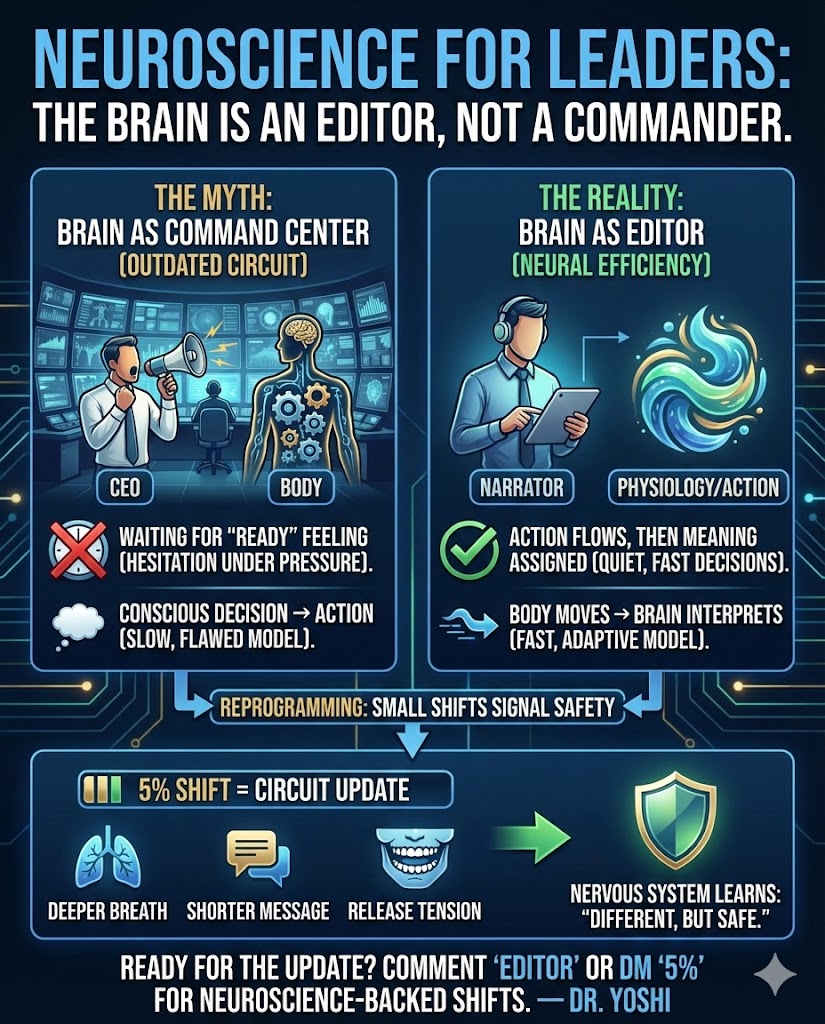
Your brain doesn’t drive behavior. It narrates it.
Most of us believe the sequence goes:
Think → Decide → Act
But the actual order is:
Body responds → Brain interprets → Story forms
By the time you consciously “decide” something, your nervous system already moved or froze. (William James proposed this in 1884. Benjamin Libet proved it in the 1980s.)
So when you freeze at a crucial moment, nothing is broken.
Your nervous system is doing exactly what it learned to do:
- Silence once reduced conflict
- Waiting once avoided risk
- Hesitation once preserved safety
These weren’t choices.
They were adaptations.
And now your brain runs that program automatically even when you know it’s time to move.
How do you reprogram this?
Not through willpower. (That’s like trying to edit a document before it’s written.)
Through safe novelty—shifts small enough that your nervous system registers “this is different” without triggering threat.
Try this 5% Protocol:
Pick ONE tiny shift for this week:
- Take one conscious breath before responding
- Send the message 10 seconds sooner than comfortable
- Release your jaw during tense moments
- Act before emotional clarity arrives
Do it three times.
Each time, your brain predicts one thing, reality delivers another, and you stay safe.
That mismatch is where neural circuits update.
After 90 days of this, a CEO told me:
“I don’t debate with myself anymore. I just move. It’s like the interference disappeared.”
Not because pressure left.
Because his nervous system stopped treating decision points as danger.
Three quick links for you:
- William James’ original essay on emotion and action — still brilliant 140 years later
- Benjamin Libet’s readiness potential experiments — the research that changed how we understand “free will”
- Predictive processing framework — why your brain is a prediction machine, not a reactor
One ask:
Hit reply and tell me: What’s your 5% shift for this week?
I read every response, and your answers help me shape what I write next.
Talk soon,
Dr. Yoshi
P.S. If you know a leader who’s stuck between knowing and doing, forward this their way. Sometimes one shift is all it takes.
🎧 Continue the neural thread:
Rewire Lab with Dr. Yoshi
EP 007 | The Switch Called Action

コメント