
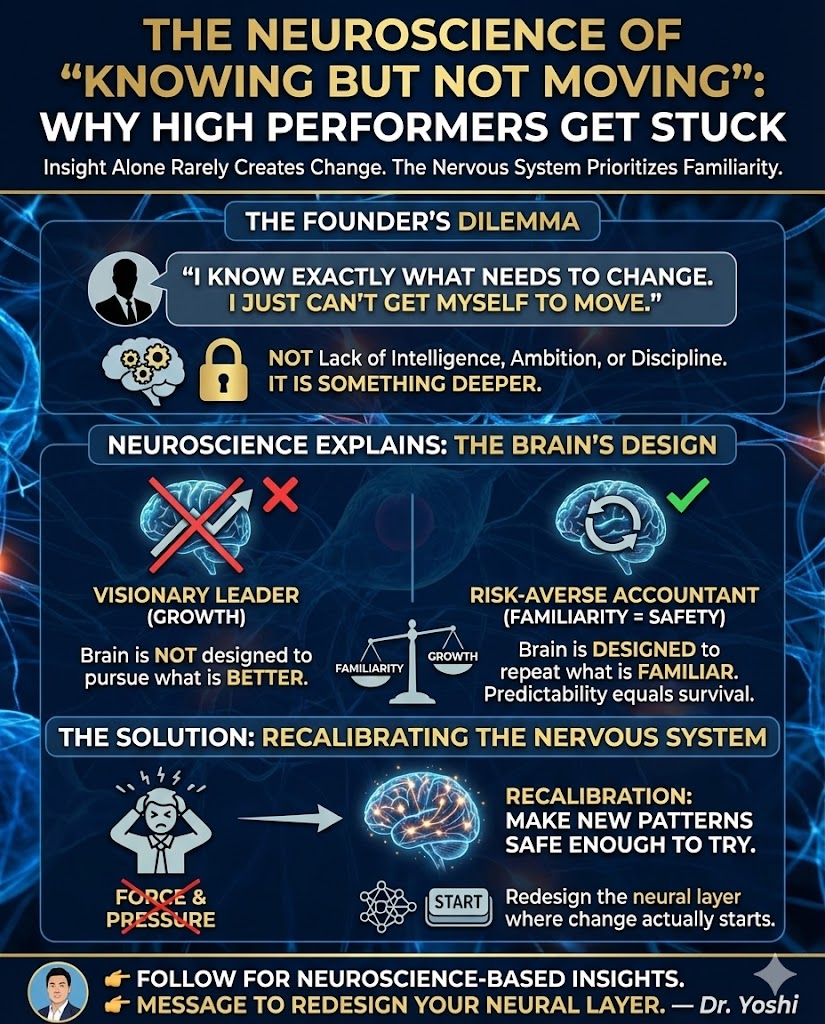
A founder once told me this in a closed session:
“I know exactly what needs to change.
I just can’t get myself to move.”
This wasn’t a lack of intelligence.
Or ambition.
Or discipline.
It was something deeper and far more common among entrepreneurs, executives, and high performers than most realize.
You see the strategy.
You understand the next step.
Yet the same patterns keep repeating:
decisions, reactions, delays you thought you’d outgrown.
From the outside, it looks like resistance.
From the inside, it feels frustratingly illogical.
The neuroscience explains why.
Your brain is not designed to pursue what is better.
It is designed to repeat what is familiar.
Not because familiar is good.
But because familiar is predictable.
And to the nervous system,predictability equals survival.
Think of the brain less like a visionary leader
and more like a risk-averse accountant.
Its primary job is not growth.
It is cost control.
Every repeated pattern such as
a thought, a reaction, a habit gets logged:
“This did not threaten survival.”
That is enough to keep it running.
Which is why insight alone rarely creates change.
And why capable leaders can see the shift that’s required,
yet feel oddly unable to execute it.
What actually creates movement?
Real change begins when the nervous system learns
that a new pattern is safe enough to try.
Not through pressure.
Not through forcing motivation.
But through recalibrating the neural systems that decide
when action is allowed.
As a neuroscientist, this is the layer I work with every day.
Not mindset.
Not willpower.
But the biology beneath them.
If this reframes how you understand “resistance” in yourself or your organization:
👉 Follow my work for neuroscience-based insights on decision-making and performance
👉 Or message me directly if you want to redesign the neural layer where change actually starts
— Dr. Yoshi
🎧 Continue the neural thread:
Rewire Lab with Dr. Yoshi
EP 005 | Why “Starting Now” Actually Matters

コメント