
The content doesn’t matter.
But a certain person appears on screen and within seconds, it happens:
An unpleasant background sound.
Aggressive comments.
Anxiety-inducing captions.
Before you can explain why, your brain has already decided:
“I don’t know what it is… but something about this person feels off.”
Here is the insight most high-performing professionals miss:
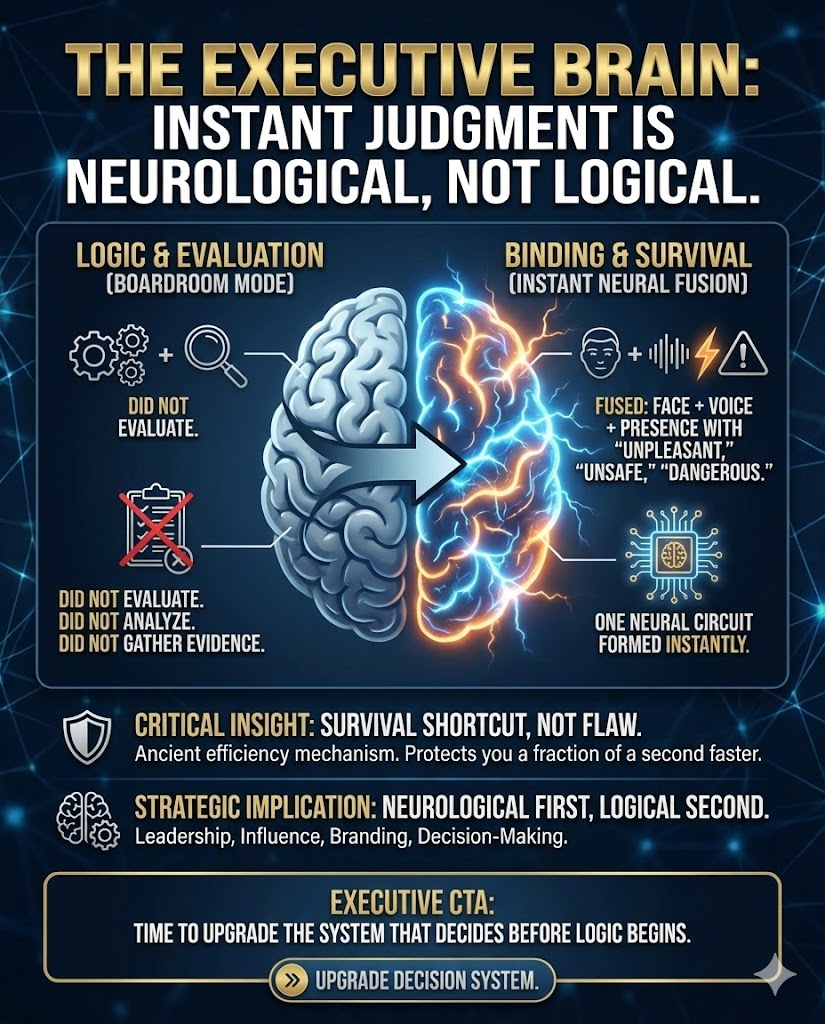
You did not evaluate this person.
You did not analyze them logically.
You did not gather evidence.
And yet, the conclusion feels real.
Why?
Because the brain doesn’t judge the way a boardroom does.
It doesn’t debate.
It binds.
In that instant, your nervous system fused:
• their face
• their voice
• their name
• their overall presence
with emotional signals like:
• unpleasant
• unsafe
• possibly dangerous
Those elements were compressed into a single neural circuit
like flipping a switch that activates an alarm system before conscious thought enters the room.
This is the part that matters most:
This is not your personality.
Not your values.
Not your intelligence.
Not a flaw in character.
It is a “survival” shortcut:
an ancient efficiency mechanism designed to protect you a fraction of a second faster next time.
And here is the strategic implication leaders cannot afford to ignore:
If your brain can form conclusions without evaluation, then leadership, influence, branding, and decision-making are never purely rational.
They are neurological first.
Logical second.
Which means:
Deals are influenced before numbers are reviewed.
Trust is shaped before words are processed.
Brands are accepted or rejected before strategy is understood.
The most effective leaders don’t fight this wiring.
They design around it.
Executive insight:
If your decisions, influence, or brand still rely on “being logical,”
you may be operating with an outdated decision system
one that quietly determines outcomes before logic ever gets a vote.
🎧 Continue the neural thread:
Rewire Lab with Dr.Yoshi
EP 002 | Memory Is Wired Together with Emotion
https://youtu.be/QdaN4Jm6j6U

コメント